‘Tune the Sensor’ to Shape Your Reality
Right now, your senses are sending approximately 11 million bits of information per second to your brain. Your conscious mind, however, can only process about 40 to 50 of them.
I find this to be a staggering discrepancy. It means that for all the details you do notice—the tone of an email, the crick in your neck, the clutter on your desk—you are missing 99.999% of the rest.
To keep from short-circuiting, the brain has to aggressively curate what makes it into awareness, leaving the vast majority of inputs on the cutting room floor. This filtering is supported by systems involved in attention and arousal, including a network at the brainstem often referred to as the Reticular Activating System (“RAS”). Its job is not to interpret meaning, but to help determine what information is allowed through for further processing.
I have often thought about the cumulative effect that this filter will have on the way we experience reality over a lifetime.
Over time, what we repeatedly attend to becomes what our lives seem to be made of: productivity, pressure, ease, belonging. These are not just stories we tell ourselves; they are patterns of attention that determine which sensations, emotions, and cues rise into awareness and which fade into the background.
As luck (or biology) would have it, we do have a hand in how our awareness is tuned. If the RAS is operating the editing suite, you’re in the director’s chair. What you implicitly tell your brain to focus on shapes your experience of life. So what is your artistic vision?
The Invisible Gorilla
There’s a quote from author Susan Jeffers that has stuck with me for years: “If you always do what you’ve always done, you’ll always get what you’ve always got.” I’ve come to understand this not just as a behavioral truth, but a perceptual one. If you maintain the same attentional defaults, your experience of life remains largely unchanged. When you begin to value something new, life opens up a bit.
This is not a call to simply “focus on the positives.” It is an acknowledgment that by design, we are blind to most of what is available to us. If we are not clear on what we are orienting toward, we miss opportunity not because it is absent, but because it never registers as relevant.
The extent of this blindness was famously demonstrated in the “Invisible Gorilla” study by researchers Simons and Chabris.
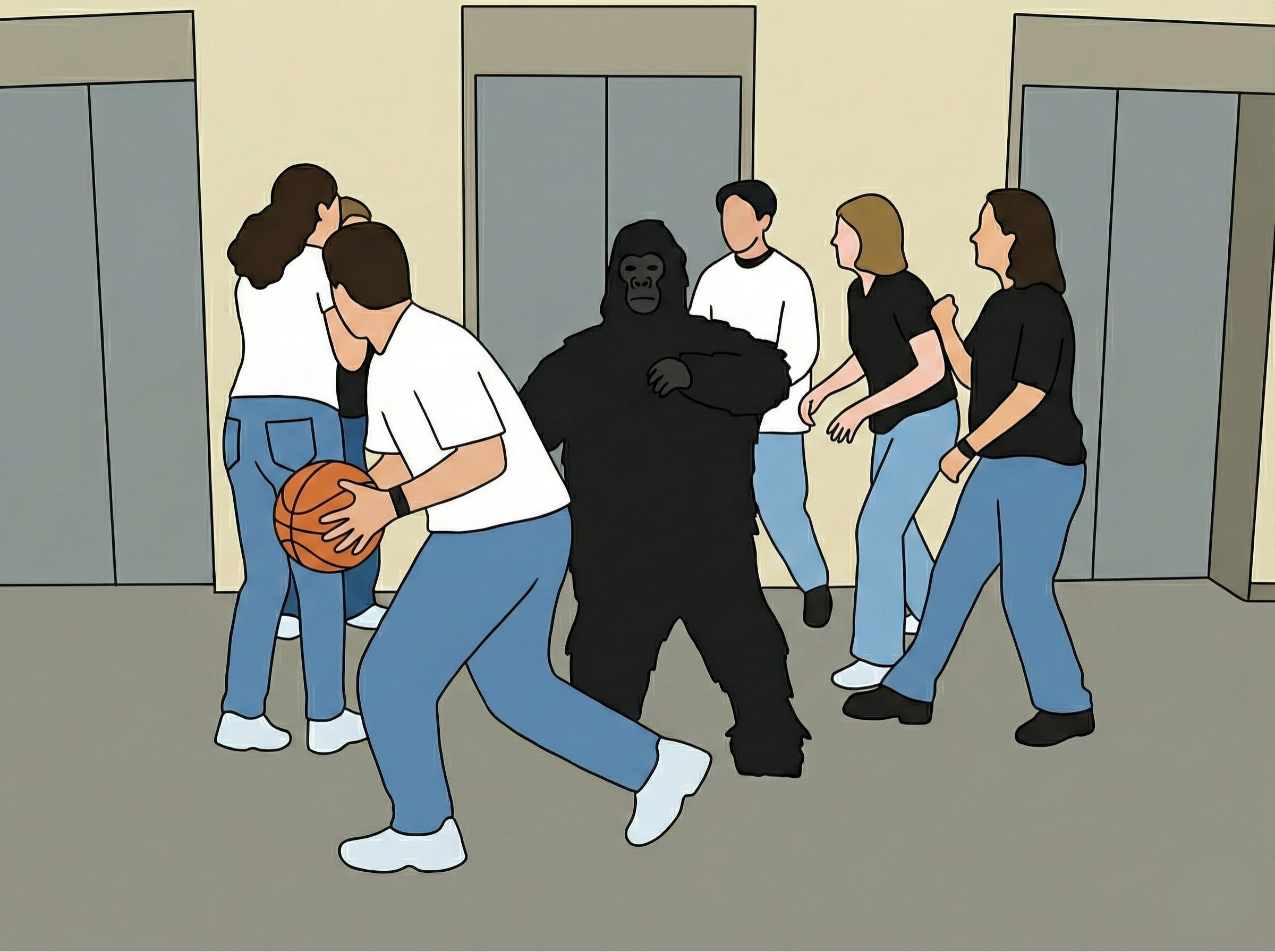
Participants were asked to watch a video of basketball players and count the number of passes. In the middle of the video, a person in a full gorilla suit walked through the frame, beat their chest, and walked off.
Half the participants didn't see the gorilla. Their brains efficiently filtered out what was not relevant to the task they had been given. This effect is called “inattentional blindness.”
We regularly miss what we have not learned to value. If your attention is set to “Efficiency,” you may not see “Connection,” even if it is a six-foot gorilla waving right in front of you.
You can feel this mechanism at work immediately. Decide that for the rest of the day, you are going to count how many times people say filler words like “um” or “like.” Suddenly, you will hear a symphony of filler words that were completely audible but invisible to you ten minutes ago. (And for that, I do apologize.)
Tuning Your Sensor
This is why “tuning your sensor,” or training your awareness, is such a powerful lever for change.
You can’t will yourself into a new experience if your mind is habitually oriented toward a narrow band of outdated signals. But when you clarify what matters to you, the brain’s filtering systems begin to work in your favor: information associated with those priorities becomes easier to notice and act upon. Like driving a car, where you place your attention subtly shapes the direction you move.
As famed psychologist and philosopher William James wrote, “My experience is what I agree to attend to.”
To change our experience, we need to be intentional about what we allow to count as significant. This is how we shift from passively ‘receiving the footage’ to actively ‘directing the cut.’
An Exercise You Can Try
You can apply the same “frequency illusion” from the filler word experiment (often called the Baader-Meinhof phenomenon) in a more meaningful way in support of your goals.
As I’ve shared elsewhere, I encourage people to root their goals in what I call a “signal,” meaning a personal constellation of internal states that serve as an orienting compass. These might include feelings like connection, steadiness, vitality, or agency.
From a perceptual standpoint, I find that internally oriented signals tend to be more helpful and durable than external targets. For example, searching for “a job promotion” narrows attention whereas searching instead for “abundance” widens it.
In this season of life, feeling deep connection has become particularly important to me. I am not constantly scanning the room for smiles, but I’m regularly registering moments of warmth, ease, and mutual presence when they arise. Those internal sensations are more likely to reach awareness because they explicitly matter to me. Personally, a journaling practice has been instrumental in fueling what I notice and what holds weight.
Whatever your signal is, practice tuning into it consciously. You can experiment with this for 24 hours.
In the morning, name what you are orienting toward. “Today, I am paying attention to moments of connection.”
As the day unfolds, notice when that feeling shows up in your body or emotional tone: a hallway conversation, a warm exchange with the barista, feeling really in sync with a teammate. If you can, make a brief note of it. After the 24 hours, spend a few minutes reflecting on the sensation that each of these moments produced in you.
By tuning your sensor toward what you value internally, you begin to notice the slice of reality that actually supports the life you are trying to build. Then you can create goals to amplify and contain it.
But first: you have to see the path to take it.
