‘Set the Signal’ To Fuel Your Effort
We are trained to plan our lives around outcomes. We ask what the future should look like: the title, the revenue target, the finished project. The theory is that once we hit the metric, a rewarding feeling will naturally follow.
But for most high-performers, we reach the destination only to find the goalposts have moved, or we arrive exhausted because we were fueled by pressure rather than desire. We chase the horizon, but the feeling of "arriving" never quite sticks.
When I was preparing to leave Google to start my coaching practice, starting from an outcomes-oriented approach didn’t make sense for me. The transition felt massive, nebulous, and open-ended. I knew I couldn’t map out every specific because I would need to build responsively as I went.
When colleagues asked what the new version of my life would look like, I struggled to give them a concrete answer. I didn’t know what would be visible from the outside, and the standard metrics—revenue targets, client volume—felt hollow and uninspiring. I couldn’t tell them exactly what I would be doing, but I could tell them exactly how I wanted to be. I would respond by saying that I wanted to wake up each morning feeling open, energized, and empowered. I felt pulled by this anticipation of spaciousness mixed with creative buzziness.
That distinct feeling became my “signal.” It steered me through the uncertainty and continues to be my driving force.
This article is about how to locate that signal for yourself and how doing so propels you forward. When you root your ambition in a specific resonance, you not only get a better goal; you gain a compass to navigate it and the fuel to pursue it.
The Science of Motivation
This is more than a poetic idea. The shift from chasing external markers to following internal resonance is the difference between burning out and staying fueled. Psychologists use Self-Determination Theory to explain that motivation exists on a spectrum, defined by how much autonomy you experience in pursuing a goal. That difference determines how much energy the effort costs you.
At the most basic level is External Regulation: doing something because you have to. “I’ll get fired if I don’t.” Most high-achievers aren’t stuck here.
More often, we get caught in Introjected Regulation. This is where pressure gets internalized. No one is yelling at you anymore—you’re yelling at yourself. You act to avoid guilt, anxiety, or the feeling of being “less than.” Because you’re constantly fighting your own resistance, this mode is deeply energy-draining.
The pivot point is Identified Regulation. Here, you consciously value the outcome, even if the task itself isn’t joyful. You’re no longer acting out of shame (I should), but out of logic (I choose to). You might not love reviewing a P&L, but you value being a solvent business owner, so you do it willingly. This state is energy-neutral. You stop leaking energy to self-judgment.
But for goals that define your next chapter, neutrality isn’t enough.
That’s where we turn to Integrated Regulation. This is when a goal isn’t a tax you pay to feel worthy or a box you check because it makes sense. It’s an expression of who you are. Action and identity are aligned, so energy becomes self-generating. This state becomes attainable when you are pursuing goals rooted in your ‘signal.’
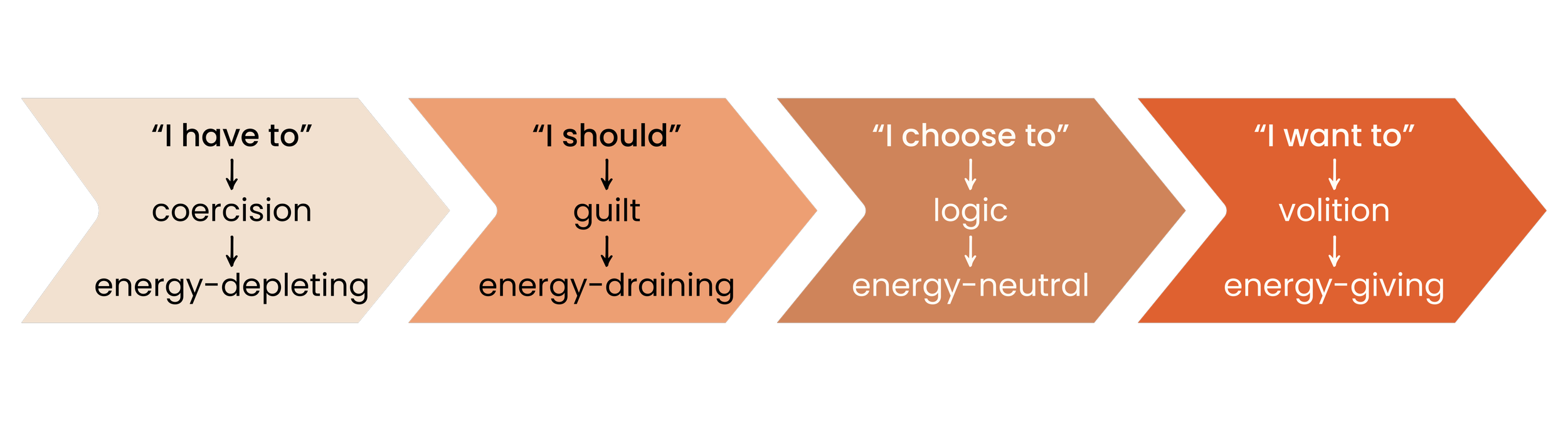
The shift from External Regulation to Integrated Regulation
Does every goal have to be rooted in a soul-shaking ‘signal’? No. You generally do not need ‘resonance’ to do your laundry. For most of life, logic is a healthy autopilot.
But when you’re navigating defining changes—or when you’re depleted enough that even the basics feel heavy—integrated motivation becomes essential. You can think of it as your heavy-lifting gear. It’s what helps you climb out of the hole or over the mountain when autopilot isn’t enough.
That’s what setting a signal is really about: choosing fuel that can actually carry you where you’re trying to go.
How to Locate Your Signal
The challenge, of course, is that you cannot simply think your way to this kind of alignment.
If you ask your logical brain what it wants for the future, it scans your past data and hands you a reasonable, safe prediction. It’s usually a slightly better version of what you already have, or something you assume you “should” strive for by default.
To find your signal, you have to bypass the logic and access the felt sense directly. We do this not by listing future achievements, but by simulating an experience.
Try This: The "Inspired Future" Exercise
This is a simple journaling prompt designed to bypass the “shoulds” and surface the “want.”
Fast-forward three years. You are living a version of your life that feels deeply fulfilling. You might close your eyes and imagine what life is like for a moment. Write a journal entry describing one ordinary Tuesday, written in the present tense.
This is not a vacation. Nothing unusually dramatic happens. You still have responsibilities. But something fundamental is different.
As you write, ignore outcomes and achievements. Focus on experience.
How do you wake up? What’s your first internal sensation?
What is the pace of your day?
What is your relationship to effort? How you feel internally as you begin your work?
What is the tone of your inner monologue as you move through the day?
Which part of the day lights you up the most?
How do you feel as the day winds down?
Read it back, ignoring logistics. Job titles, locations, and schedules are just packaging. Look instead for the emotional through-line. Pressure-test it, asking yourself “why?” a few times until you feel like you’ve reached the core essence of this desired feeling.
That feeling—the way the day moves from the inside—is your signal.
It’s often difficult to describe in a single word; for example, maybe it’s a blend of sturdiness and freedom and connectedness. It’s helpful to distill it into something you can easily reference: maybe you give it a name, associate it with a specific memory, attach a visual image to it, or choose something in nature that represents it for you. Whenever you think of it, it should stir up an embodied sense of that feeling. This will help you “feel into” your signal and use it as a compass to navigate decisions, priorities, and your goals.
You can hone your ability to do so by “tuning your sensor” such that you become more sensitive to glimmers of your signal as it shows up day to day.
What Comes Next?
When I was making my transition out of Google, I kept coming back to a line from John O’Donohue’s For a New Beginning, a poem that beautifully articulates the threshold of change: ‘Soon you will be home in a new rhythm / For your soul senses the world that awaits you.’
That line captured what I couldn’t yet articulate. I didn’t know the shape of what I was building, but I could feel the rhythm I was moving toward. That feeling, more than any plan, became my orientation and fueled my drive.
Once you have identified your signal, two things help bring it to life: learning to notice it in the life you already have, and making choices that protect and amplify it. I developed a goal-setting approach called STARS designed to do just that, and “setting the signal” is the first step.
As you look toward the future, it might be worth asking:
What feelings signal to you that you are moving in the right direction?
What internal state are you implicitly chasing through your current goals?
Which parts of your life feel most fueled? Which feel most draining? Where might a different kind of fuel be needed?
If you trusted your signal as a compass, what new choices would you make? What might you stop pushing so hard for?
