Escape the Waiting Room: The STARS Framework for Sustainable Ambition
In a crisis or acute need, goals set themselves. Instinct takes over, urgency kicks in, and the next step is obvious.
It’s in the moments of comfort and steadiness that we actually lose our way.
Growth becomes elective, and without an emergency forcing our hand, it’s easy to drift into a life that feels arrived at by default. We miss out on the buzziness of possibility, replaced instead by a subtle existential feeling of being stuck or directionless.
So how do we find what’s worth reaching for when nothing is technically wrong?
The STARS framework for personal goal-setting was born from a crisis of utility. As I built my career at Google, I became an expert in traditional goal-setting—in fact, for many years I led the process for the global Finance team. But when it came time to design new chapters in my own life, defining outcomes, metrics, and KPIs felt overly constricting. Outcomes-first goals created internal pressure and became a recipe for burnout and frustration.
If, like me, you have ever hesitated to name what you want because you fear falling short, or because perfectionism makes progress feel all-or-nothing, you are not alone. Ambition and anxiety often travel together.
All-or-nothing goals operate on a When/Then equation: When I get that promotion, then I will feel secure. When I launch this business, then I will feel free. This approach asks you to mortgage your present happiness for a future payoff, turning the space between where you are and where you want to be into a waiting room. You spend your days pushing through the process, hoping the achievement will finally deliver the feeling you’re craving. When you arrive, the feeling is fleeting, the goalposts shift, and the waiting game begins again.
I realized I needed a more sustainable way forward that allowed for flexibility without sacrificing ambition. So, I stopped optimizing for what I wanted life to look like and started optimizing for what I wanted life to feel like.
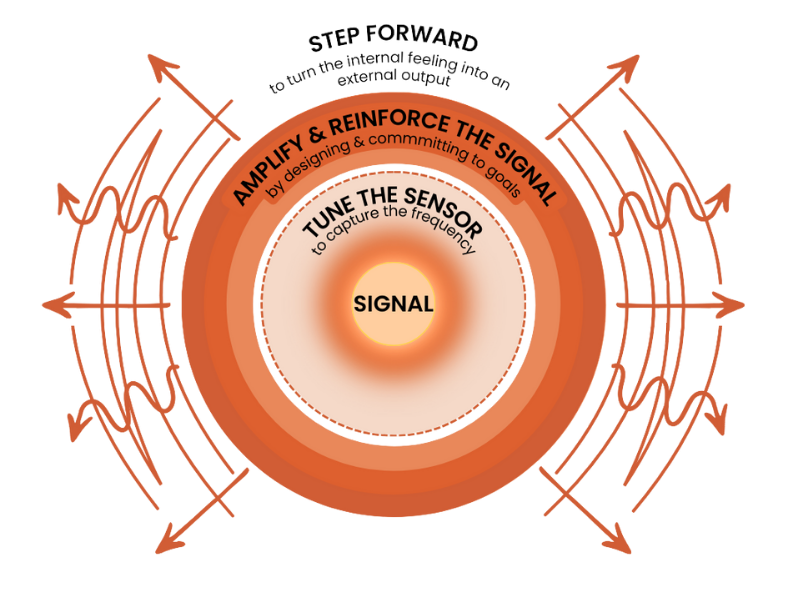
Instead of treating achievement as the source of a future feeling, the STARS method starts with the feeling itself, or the ‘signal,’ and uses the goal as a vehicle to amplify it today.
By starting internally and moving outward, this approach is designed to keep your external action aligned with your internal motivation. If traditional goal-setting tends to create pressure or paralysis, I hope this offers a more sustainable way forward.
S — Set the Signal
Name the feeling you want more of, not a standalone achievement. Maybe it’s agency, steadiness, vitality, belonging, or your own personal blend. This feeling becomes your internal signal.
What feeling do you want greater access to in your life? By naming the destination as an internal state rather than an external milestone, we create emotional resonance with our goals. We often mistake motivation for willpower, but willpower is a finite resource, and white-knuckling anything is inherently depleting. Deep, consistent drive comes from emotional resonance, inspiration, and action that is in harmony with how we want to feel.
Take a moment to jot down the constellation of feelings that make up your internal state when you are at your most fulfilled. If you’d like a simple exercise to help you locate your signal—and want to explore the psychology behind the effectiveness of doing so—you can read more here.
T — Tune the Sensor
Begin noticing where that feeling already exists in small doses. It’s usually diluted, not absent.
Like teaching a dog to follow a scent, the next step is to train your awareness to recognize the feeling in the wild. If you are seeking more peace, perhaps your morning cup of coffee provides you with a taste. As you pay attention to that sensation, your brain begins to filter your reality for it. Savoring the feeling develops an embodied sense of the reward, a deep-rooted instinct for how to find it, and a felt appreciation for the progress you make along the way.
Whatever your signal is, practice tuning into it consciously and reflecting on your “felt memories” from when it has shown up previously. Here’s a deeper look at how attentional tuning works and a simple exercise to practice it.
A — Amplify by Design
Design a goal—and a process—built not out of a “should,” but out of a desire to expand something that already energizes you.
Once you’ve named your “signal” and started tuning into where it already exists around you, this next step invites you to design a vehicle to amplify it by setting a goal for yourself.
In the STARS framework, a goal is not a verdict on your worth or a heavy obligation you “should” pursue. It is simply a designed playground—a project, practice, or pursuit—built to give you greater access to a feeling you already know that you love and want more of.
For high-achievers living in comfort, the concept of personal goal-setting often feels dangerous. Perfectionism turns big aspirations into high-stakes tests, making it safer to drift along in default mode than to risk setting a goal and falling short. “Amplify by design” is about stripping away that fear and self-judgment and instead creating from a sense of inspiration.
I like to say “inspire” is a verb. We are going to leverage your appreciation for your signal to inspire you to action. That’s the whole idea, really!
When you design your goal from this posture, the process itself becomes self-reinforcing. You aren't white-knuckling your way to a distant finish line to fix a deficit; you are engaging in an experience that feels buzzy, generative, and rewarding right now.
To design your goal around amplification, ask yourself:
What project, experiment, or practice would feel like a fun, expansive playground for this feeling?
How can I design my daily process so that simply engaging in the work gives me more of what I love today?
When goal-setting shifts from an act of self-judgment to an inspired act of self-authorship, the fear fades. You stop waiting for an external result to give you permission to expand, and start building a life that feels intentionally created by you.
R — Reinforce Belief
Trust your track record and keep the stakes in perspective.
Once you’ve designed an expansive goal, a subtle form of hesitation can sneak in. Perfectionism loves to convince us that we need absolute certainty or a guaranteed outcome before we’re allowed to begin.
But remember: this goal is a playground, not a test. You don’t need to prove your worth. You just need to build a little trust with yourself.
First, anchor in your track record. Your brain is quick to highlight what you haven't done yet, but you already have a lifetime of evidence showing you are adaptable, resourceful, and capable of learning on the fly. Look back at past wins, skills you’ve picked up along the way, or times you navigated unknown territory. You don't need a flawless roadmap; you just need a gentle reminder that you know how to figure things out.
Second, treat the process as an experiment. If a goal suddenly starts feeling heavy, it’s usually because you’ve attached a high-stakes verdict to it. Swap out the pressure-filled question "What if this doesn't work?" for a much lighter one:
“What if this is just an experiment?” Or even better: “What if it’s easy?”
When you frame your pursuit as an invitation to explore rather than a test you can pass or fail, the artificial pressure evaporates, leaving you with the safety and space to simply begin.
S — Step Forward
Act before you feel ready. Movement creates momentum.
It’s easy to believe action should follow confidence, but we actually learn who we are and what we are capable of by observing what we do. As author James Clear put it, “Every action you take is a vote for the type of person you wish to become.”
So, choose your move. Look for cheap momentum: actions with a low barrier to entry that unlock a taste of the feeling you’re working to amplify. That initial spark kicks off an upward spiral, giving you a real-time hit of proof that energizes the next step.
If you’re tempted to let the discomfort of doing something awkwardly stop you from taking those early steps, consider advice a friend once gave me: don’t get stuck wanting to be “the kind of person” who wears hats—just start wearing hats. At some point, you either realize you don’t care for hats, or you move from wearing a costume to wearing an outfit.
There’s a secondary effect, too: how you move through the world shapes the world around you, which in turn shapes you. Action does more than nudge your internal state; it alters the terrain you’re moving through. As that feedback loop compounds, resistance starts to lose its grip.
Remember: the “perfect next step” is a myth. You can course-correct as you go. Just put on the hat.
From “Hunting” to “Creating”
To see the difference, consider two approaches to building relationships.
A traditional, outcome-first goal might be: “Add 50 people to my professional network this year.” The trap is that the goal becomes a chore. Because you’re chasing a number, the process feels transactional. You enter rooms as if you are auditioning for new relationships, waiting to hit the metric before you feel successful.
Now apply the STARS approach. You recognize your desire for relationships is rooted in a love of feeling connected. You notice you feel most connected when you bring people together. So you design a goal to amplify that: host a monthly dinner party for four people you admire. You reinforce belief by recalling you’ve hosted before and that if plans fall through, the cost is low. The first step is simple: text a friend and suggest dinner next month. Even the simple act of reaching out and inviting ignites your connection signal.
In the traditional approach, you’re “hunting” for connection. In the STARS approach, you’re creating it. The goal becomes a mechanism for inhabiting your signal today.
As you think about your own goals, it might be worth asking:
What feeling am I actually trying to access through them?
Where do I already experience traces of it?
And what would it look like to design my process to reinforce that feeling instead of waiting for it?
