Stop Metabolizing Your Work
I spent a decade at Google. Over time, I let my identity grow around the company like a vine on a trellis. It wasn't just where I worked; it was the architecture of my life.
When the first-ever company-wide layoffs happened in 2023, it forced a reckoning. I saw how much of my sense of self was still anchored to being a “Googler.” It wasn’t that I loved my job any less, but I had let the role do more identity work than it should have. I began the necessary work of untangling the vine, updating my narrative and making peace with the fact that "Grace" and "Google" were two different entities.
I thought I had successfully decoupled… But I missed a spot.
While I had detached from the identity of the company (the logo, the prestige), I was still deeply enmeshed in the operations of the work itself.
If my team hit a snag, I didn’t just problem-solve; I metabolized it. I would carry the weight of a strategy deck in my chest, waking up at 2 AM running simulation loops. The mistake wasn't the effort—it was often my job to solve these problems. The mistake was that I was treating a Systems Problem like a Personal Problem, confusing "caring" with “absorbing.”
I was hired to apply my abilities to the Google system. Instead, I was absorbing the system into myself.
Becoming a Pro
To conceptualize this in concrete terms, I’ve been thinking about the difference between a homeowner and a contractor—let’s say, a plumber.
If you walk into your own basement and see it flooding, you panic. You see ruined carpets, lost memories, and a massive bill. You have no distance from the problem because it is your house. The water feels personal.
But when a plumber walks into that same flooded basement, the stakes are different. They don't fall into an existential crisis about the water level. They don't weep for the carpet. They enter with a clear role. They have a truck outside. They have a toolbelt. They assess the pressure and apply the wrench. They do the work with high expertise and high impact because it is their craft.
The plumber is not indifferent; they still “own” the problem in the sense that they take responsibility to solve it. They are effective because they are applying the skills they were hired for while maintaining emotional distance from the feeling of disaster. When they drive away at 5 PM, they don't worry that their house is flooding.
The Cost of the Homeowner Mindset
The mistake I made, and the mistake I see so many high-performing clients make, is collapsing identity and assignment. We confuse being "all in" with being the homeowner. We tell ourselves that losing sleep is proof of our dedication; that "feeling the pain" is the same thing as "taking ownership." The trap is that the homeowner mindset feels virtuous. It looks like dedication, but it is often mistaken identity—and it comes at a cost beyond discomfort.
I sketched this as a simple matrix of impact versus operational distance, because where we land on those two axes determines whether work feels empowering or crushing.
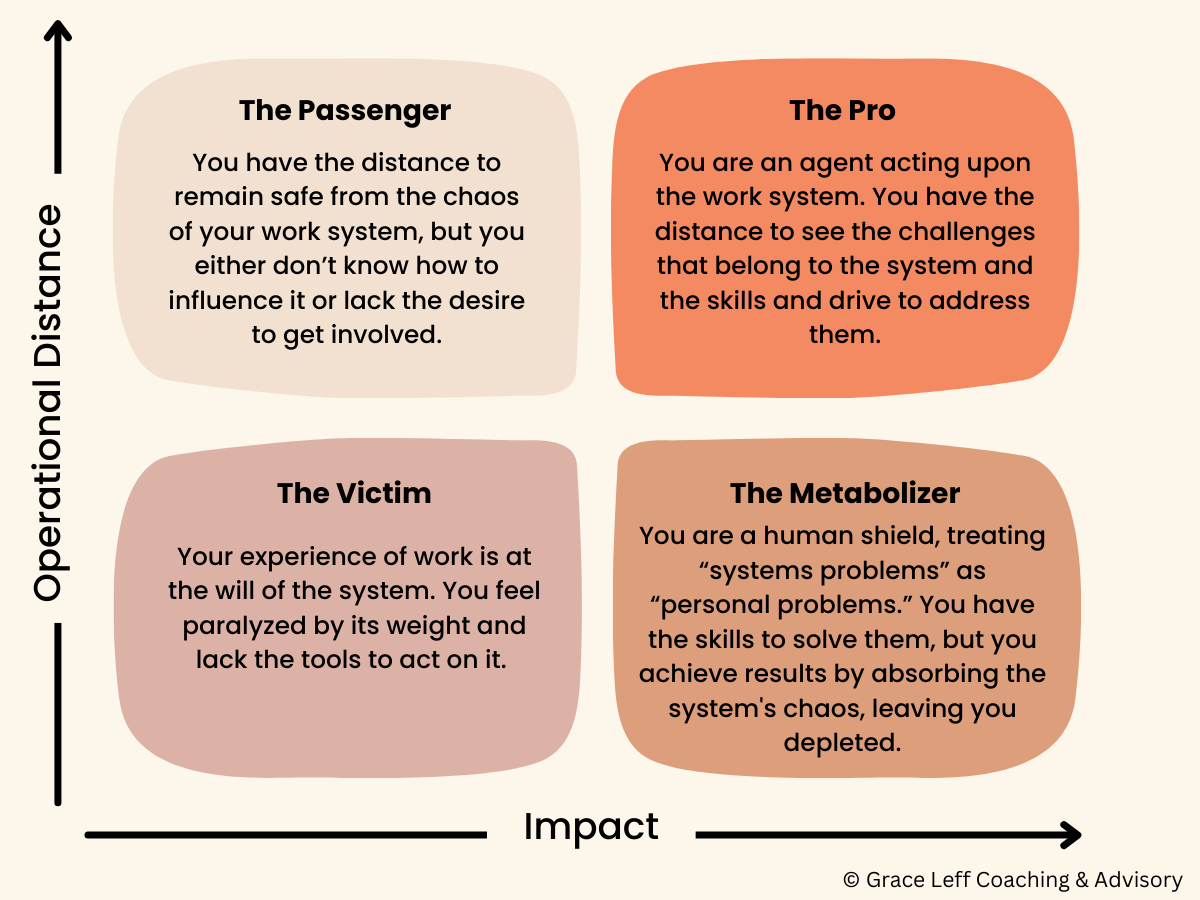
In practice, the homeowner—or metabolizer, in the chart above—is a liability in a crisis because the homeowner is too close to the problem. Because it’s their house, they make decisions based on fear, protection, and sunk cost. When the water rises, they panic.
In contrast, the plumber—the pro—has operational distance. Because it’s their craft, they make decisions based on physics, logic, and expertise. When the water rises, they get to work.
When you are enmeshed with your work, you lose your executive sight. You stop seeing the data and start seeing the threat. You make emotional decisions (to assuage your anxiety) rather than strategic ones (to solve the problem). Because you are so close to the problem, you often end up protecting dysfunction, avoiding necessary conflict or structural changes because fixing the house feels too painful or exhausting.
Worse, you might even become volatile. If you are the homeowner, your mood rises and falls with the water level. Your team tiptoes around you in fear of springing a leak.
The good news: you were not hired to move into the basement. You were hired to show up with the tools.
Absorbing vs. Applying
The unlock is to shift from Absorbing the System to Applying the Tools. The difference is the direction of the flow.
When you absorb the system, the context is the active force. It moves through you. The stress of the basement travels with you into the car, onto the train, and into your living room. You become the container for the problem.
When instead you simply apply the tools, you are the active force. You move through the context.
You are the constant. Your "youness" (your rigor, your wit, your values) is the toolbelt. It is solid and portable. The context is the variable. Sometimes the context is a "Strategy Crisis." Sometimes the context is "Dinner with Friends."
You visit the crisis. You enter the room, reach into the toolbelt, and deploy the appropriate skills. You work hard. When you leave the room, you bring your skills home (you are still smart, capable, and kind), but you do not bring the water home.
We might be tempted to solve this boundary problem with scheduling, debating "Work-Life Balance" (hard walls) vs. "Work-Life Integration" (fluid weaving). Neither will get to the heart of the issue if the internal boundary is missing. Trust me, there are signs:
If you have "balance" but you spend your weekend fighting off the Sunday Scaries
If you have "integration" but you are unable to be fully present in your personal ventures
If you have a hard time prioritizing a personal life because the to-dos of your personal life feel like they stand in opposition to the to-dos of your work life
I’m less interested in what percentage of your thoughts are work-related and more concerned with the texture of your connection to the work. You can contemplate a work project while chopping vegetables on a Tuesday night without cause for alarm if it feels engaging. But if you are thinking about your work with the existential dread of a homeowner watching their investment sink, you are metabolizing it.
Changing The Equation
If you feel like you are drowning in your company's problems, it is usually because you have stopped treating them as puzzles to solve and started treating them as weights to carry.
To get your boundaries back, you need to define the operation. Before you step into a high-stakes room, try running this equation:
I am using [X Skill]... Applied to [Y Context]... To serve [Z Outcome].
Example: "I am using my [Analytical Clarity] applied to [This Budget Crisis] to serve [The Team's Ability to Move Forward]."
This formula forces a psychological wedge between you and the stress. It reminds you that the problem is external (the context) and your value is internal (the skills in your toolbelt). You are no longer the container for the chaos; you are the agent acting upon it.
This allows you to stand on your own two feet. You can care deeply about the work without being consumed by it. You can see the water rising, stay dry, and ask: "Okay, which wrench do we need?”
As you think about what’s on your plate right now, ask yourself:
Where am I carrying something that actually belongs to the system?
What am I treating like a threat instead of a problem to solve?
If I showed up as a contractor with a toolbelt instead of a homeowner in a flooded house, what would I do differently this week?
